
Why Short ‘Swim to Bike’ Brick Repeats Might Be the Most Underrated Triathlon Session You’re NOT Doing
Most age-group triathletes naturally organise their training into separate swim, bike and run sessions, and when they do include a ‘brick’ session it’s typically a bike-to-run workout. This is practical, specific and time-efficient, but for long-course triathletes I don’t see many swim-to-bike combinations being used in the same way. It’s often assumed this is the domain of short-course racing, but we may be missing both a valuable physiological training stress and an opportunity to better prepare for one of the most important parts of a 70.3 or IRONMAN.
When I refer to this added training stress, I’m thinking about how combining two different movement patterns back-to-back increases the overall cardiovascular demand in a way that is difficult to replicate in single-discipline training. This idea loosely aligns with Peripheral Heart Action style training, where alternating demands across the body increase cardiovascular load without relying purely on local muscular fatigue. This is because you’re effectively shifting from upper-body-dominant work straight into lower-body-dominant work, which challenges the body to rapidly redistribute blood flow between muscle groups, increasing the demand on the heart to maintain oxygen delivery and stabilise the system under changing conditions.
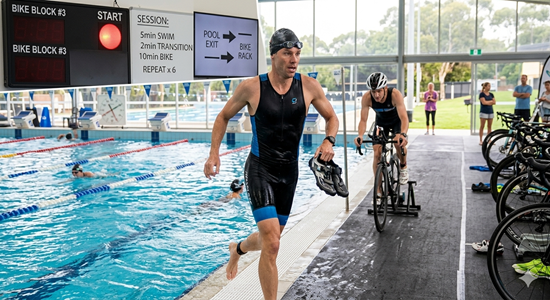
The physiology - why this works
From a physiological standpoint, the defining feature of these sessions is that you repeatedly start the bike with an already elevated heart rate and breathing rate, which changes the way your body responds to the work that follows. You are no longer building gradually toward higher oxygen consumption but instead beginning each effort closer to your aerobic ceiling. This shortens the delay in oxygen uptake and allows you to spend more time working at a high aerobic demand without necessarily increasing the absolute intensity of the effort.
At the same time, your body is dealing with a shift from a horizontal, upper-body-dominant activity to a vertical, lower-body-dominant one, which requires the cardiovascular system to redistribute blood flow while you are still under load. That redistribution adds a layer of stress that is both meaningful and specific to triathlon, especially when repeated multiple times within the same session.
What you are really training here is not just fitness in isolation, but how the system behaves when multiple demands are layered on top of each other, which is far closer to the reality of racing than most standalone sessions.
What makes this type of session particularly useful is that it can be applied in two different ways depending on how it’s structured. If the swim and bike efforts are both short and hard, then the elevated heart rate and faster oxygen uptake can be used to increase the time spent working near VO₂, effectively turning it into a high aerobic stimulus. If the swim is short and hard but the bike is longer and more controlled, then the value shifts toward race execution, as you learn to settle your effort, control pacing, and manage the early stages of the bike when heart rate and breathing are still elevated.
This is where short, repeated swim to bike intervals can add real value, not as a one-dimensional session, but as a flexible tool that can target both physiology and execution depending on how it’s applied. Instead of completing a continuous swim followed by a continuous ride, this session breaks things into multiple short blocks where you swim for a few minutes, transition quickly, ride for a few minutes, and then repeat several times, effectively giving you multiple exposures to that early-bike state within a single workout. While it might not look particularly complex on paper, it introduces a very specific type of stress that most long-course athletes rarely train deliberately.
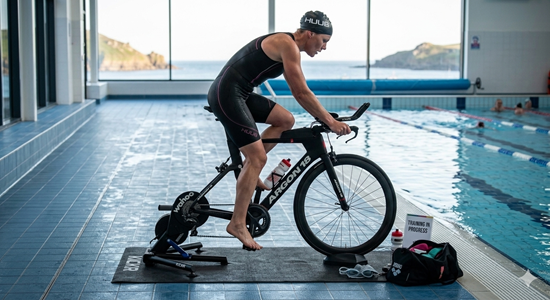
The specific skill - learning how to pace this portion of the race
From a triathlon-specific standpoint, the additional benefit is that you develop familiarity with these sensations, because the effort coming out of the water almost always feels harder than expected, and many age-group athletes either push too hard in response to the elevated heart rate and adrenaline or back off too much because the discomfort feels out of proportion to the pace.
By repeatedly training this exact moment, you begin to normalise the sensation of starting the bike under stress, and you develop the ability to settle into your effort more quickly, which is one of the most valuable but least trained skills in triathlon.
You improve your ability to stabilise under stress
Coming out of the swim, breathing is often erratic, heart rate is elevated, and there is a general sense that things are slightly out of control. While experienced athletes learn to manage this instinctively, many age-groupers never really train it directly.
These sessions give you repeated opportunities to practise regaining control, allowing you to stabilise your breathing, bring your heart rate under control, and find rhythm on the bike without overreacting to the initial sensations, which over time builds confidence and composure in a part of the race that often feels chaotic.
You sharpen pacing awareness when sensations are misleading
One of the biggest challenges in triathlon is that internal sensations don’t always match external output, particularly early in the bike when everything feels harder than it should, and this often leads to poor decision-making if you rely too heavily on what the data is telling you in that moment.
By training in this state repeatedly, you begin to recalibrate your perception of effort, learning how race effort should feel even when your body is already under load. This helps you trust your pacing strategy and avoid the common mistake of either overcooking or underperforming early in the ride.
How to use it in training
In practice, these sessions don’t need to be overly complicated, and they are often most effective when the focus stays on execution and what you are specifically trying to achieve.
If the goal is to create a stronger cardiovascular stimulus, then multiple rounds of a short, hard swim followed immediately by a few minutes of hard riding can elevate heart rate and oxygen demand quickly, allowing you to spend more time working near your upper aerobic limits.
If you want to develop the ability to pace the first part of the bike when internal sensations don’t always match external output, use a short, fast swim followed by a longer, more controlled bike interval at race power or RPE targets, allowing heart rate to gradually stabilise while you hold your intended effort.
These sessions tend to work best when included deliberately within the training week, particularly in the lead-up to a race or during phases where the focus shifts toward execution rather than simply accumulating volume, as they add a layer of specificity that is often missing from more traditional swim and bike sessions.
The takeaway
Short swim to bike repeats are not just about challenging physiological ceilings but about improving how your system behaves when it is already under pressure - which is exactly what racing demands. For many age-group athletes that shift from simply building fitness to learning how to apply it effectively is where meaningful performance gains are still waiting.
Bevan McKinnon / April 2026