
VO₂max Training (Part 1): Are You Measuring the Right Thing?
POWER is the prescription. PHYSIOLOGY is the target. ADAPTATION is the outcome.
Ask a group of triathletes what determines whether a VO₂max workout has been successful and you’ll probably hear answers like:
“I hit all my target watts.”
“I averaged 340 watts for the intervals.”
“I didn’t fade during the final repetition.”
They’re all perfectly reasonable answers and they’re all describing the same thing: what you did, not what your body actually experienced while you were doing it. That distinction looks small on the page, but it changes how you should think about interval training almost completely.
The purpose of a VO₂max workout is never simply to produce high power. It’s to create a physiological stress that pushes your aerobic system to adapt. Power is just one of the tools we use to create that stress. Adaptation happens because of what your body does in response, not because a number appeared on your head unit.
Before going any further, it's important to understand what VO₂max actually is. It's the ‘maximum rate at which your body can take in, transport and use oxygen to produce energy aerobically’. Essentially it’s the size of your aerobic engine. It reflects the combined capacity of your lungs to take in oxygen, your heart and blood to deliver it and your muscles to use it.
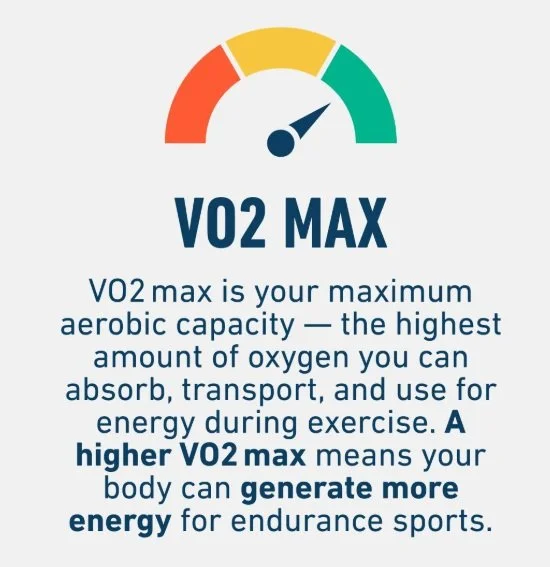
VO₂max matters because it sets the ceiling on how much energy you can produce aerobically. It doesn't determine performance on its own - how much of that ceiling you can sustain and how efficiently you use it matter just as much - but it does define the upper limit everything else works within. That's why VO₂max training exists: not to make every session feel maximal, but to push that ceiling higher over time."
Every Workout Has Two Stories
For simplicity I'm using cycling numbers throughout these blogs, since power gives the cleanest external load examples. The same logic holds for pace on the run or per 100m splits in the pool - external numbers you hit versus the internal cost of hitting them.
Imagine you’ve just completed a hard interval session. You upload the file and immediately start scanning the data: average power, normalized power, cadence, speed, distance, maybe even a new five-minute power best. These numbers tell one story about what happened outside your body. Coaches call this the external load and it describes what you asked your body to do.
But another story unfolded during exactly the same workout. Your heart rate rose, your breathing became progressively heavier and your cardiovascular system worked harder to deliver oxygen to your muscles. Your muscles consumed energy, metabolic by-products accumulated, fatigue developed and recovery began. This is the internal load, the cost your body paid to produce the external workload.
Power tells us what we asked the body to do. Internal load tells us what it cost the body to do it. And it’s this internal stress, not the watts themselves, that actually drives adaptation.
Think about this… Imagine two athletes both ride 340 watts for four minutes. Did they experience the same physiological stress? Almost certainly not. For one athlete it may have represented an all-out effort; for another it may have been comfortably repeatable. Same external workload, completely different internal response.

📷 Trainer Road
Power Actually Has Two Jobs
This is where I think many athletes get confused about High Intensity Interval Training (HIIT). Power matters enormously, just maybe not for the reason most of us assume. It does two distinct jobs within a session.
Job One: Power Is the Prescription
Before a workout even begins, power is one of the most valuable coaching tools we have. If today’s objective is to create a substantial aerobic stimulus, we prescribe a power that we believe will place the athlete under the appropriate physiological strain. We’re not prescribing 340 watts because 340 watts is somehow magical. We’re prescribing it because we believe it will produce the internal response we’re trying to create. Power is the steering wheel; physiology is the destination.
Job Two: Power Becomes the Progress Marker
Now imagine six weeks have passed and the athlete repeats exactly the same interval session. Their RPE (Rate of Perceived Exertion) is similar, their recovery is similar, their heart-rate response is similar, but instead of averaging 340 watts, they’re now averaging 355. Suddenly the power becomes meaningful, not because higher watts are inherently better, but because the athlete produced more external work for a similar internal cost. That’s adaptation: the aerobic system improved. And to keep driving it forward we may need to raise the prescribed power to recreate the same physiological stress. The physiology stayed the target. The power prescription simply evolved alongside it.
Not Every VO₂max Session Uses Power in the Same Way
This is also why comparing interval sessions on average power alone can be misleading. Some formats deliberately manipulate physiology rather than chase a higher power average - fast-start intervals, 30/30s, 40/20s, 30/15s, high or low cadence VO₂ intervals - often sit well below the average power of a traditional 4 × 4-minute session, and yet they can still produce a very large aerobic stimulus. That’s because they manipulate how your cardiovascular system responds, rather than simply raising the average external workload. Different interval structures can produce similar physiological stress through different combinations of power, cadence and recovery, and in some cases they suit different athletes with different physiological capacities (more on that in Part 2). Power remains important. It just isn’t the only tool available.
So What Are We Actually Trying to Stress?
This brings us back to the original question: if power isn’t the goal, what is? Over the past decade, research has increasingly pointed to one of the key drivers of aerobic adaptation - the amount of time spent working at a very high percentage of maximal oxygen uptake, or VO₂max. In simple terms, the aim is to spend enough time asking the aerobic system to work close to its ceiling. Notice what isn’t mentioned: power. It’s one of the ways we encourage that response, not the response itself.
A Practical Window into Physiology
If the goal of a VO₂max session is to maximise time spent near that ceiling, an obvious question follows: how do we know whether we’ve spent enough time there?
In a research lab this is straightforward. Athletes wear a metabolic mask, their oxygen consumption gets measured breath by breath throughout the workout and researchers can calculate exactly how much time was spent working above roughly 90% of VO₂max - a benchmark that’s been repeatedly linked to a strong aerobic training stimulus.
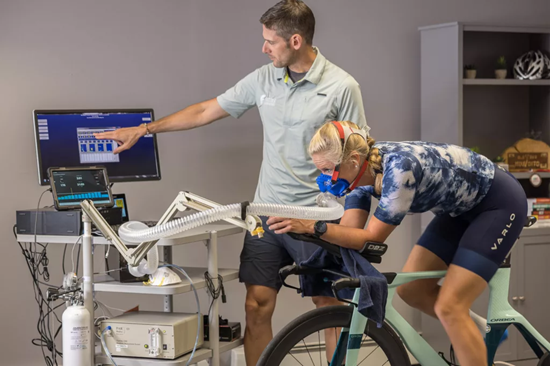
📷 Pro Cycling UK
Most of us don’t train in a lab, though. We don’t have real-time VO₂ data, so coaches have spent years looking for practical proxies, ways of estimating whether a session actually produced the intended physiological stress. The simplest one available to almost any endurance athlete is heart rate.
Heart rate isn’t the same thing as oxygen consumption; it’s influenced by hydration, fatigue, heat, altitude, caffeine and psychological stress, and it should never be treated as a perfect substitute for VO₂. Still, it may offer a useful window into the internal load a workout actually produced.
There's some early support for this: research comparing heart-rate-based and directly measured VO₂ markers has found that time spent at a high percentage of maximum heart rate (90%+) is a noisier signal of aerobic adaptation than VO₂ itself, but it still points in the same direction. Athletes who sustained higher percentages of their maximum heart rate tended to see greater improvements in aerobic performance.
None of this makes 90% of maximum heart rate a magical threshold, and it doesn’t mean the workout should turn into a heart-rate chase. What it gives us is a practical question to ask afterwards: how much time did I spend working above roughly 90% of my maximum heart rate? That’s not because heart rate is the goal. It’s because time spent there is a decent sign the aerobic system was under real physiological stress for a meaningful stretch of the workout.
RPE is often suggested as a workaround here, but it isn’t a clean substitute either. It carries its own confounders, heat and psychological stress inflate RPE much like they inflate heart rate, and motivation or mental fatigue can shift it in ways heart rate never will. RPE also tends to climb steadily through a session rather than plateau near a ceiling the way heart rate and VO₂ do, so it’s a weaker tool for judging how much time you actually spent near your limit.
Power helped create the stress. Heart rate helps us evaluate whether it landed. RPE is a useful third check, but it isn’t a replacement for either.
Coach’s Notebook
One of the biggest shifts an endurance athlete can make is recognising that success isn’t defined solely by the power they produce. Power tells us what was prescribed; heart rate offers one window into the physiological response, and adaptation happens somewhere in the relationship between the two. The goal was never just to produce more watts. It’s to create the right internal stimulus and, over time, produce more watts from that same physiological cost.
Looking Ahead
If heart rate offers a window into the internal stress of a workout, another question follows naturally: why can two athletes complete exactly the same interval session, at exactly the same relative intensity, and still spend very different amounts of time under substantial aerobic stress? The answer likely lies in how their aerobic systems respond to high-intensity effort.
In Part 2 we’ll explore two useful coaching concepts, ceiling-limited and kinetics-limited athletes, and look at how understanding these physiological differences can help individualise interval training rather than assuming one workout fits everyone.
Bevan McKinnon / July 2026
References:
Rønnestad, B.R., Hansen, J., Nygaard, H., & Lundby, C. (2020). Superior performance improvements in elite cyclists following short-interval vs effort-matched long-interval training. Scandinavian Journal of Medicine & Science in Sports, 30(5), 849–857.
Odden, et al. (2024). The higher the fraction of maximal oxygen uptake, the greater the cycling performance gain. European Journal of Sport Science. (10-week trial comparing training at ~90% vs ~70% of VO₂max power output; found percentage of VO₂max tracked performance adaptation more closely than percentage of HRmax.)
Fusco, A., et al. (2020). Session rating of perceived exertion and internal training load monitoring. Frontiers in Physiology. (Basis for the RPE discussion: RPE rises progressively across a session rather than plateauing near a ceiling, and session-RPE captures accumulated fatigue that heart rate and lactate can miss.)