
VO₂max Training (Part 2): One VO₂max Workout Doesn’t Fit Everyone
Why two athletes can complete the same session but receive a different training stimulus.
In Part 1 we introduced an idea that challenges the way many endurance athletes think about interval training: power isn’t the goal. Power is the prescription. The goal is to create the right physiological stress so the body is encouraged to adapt.
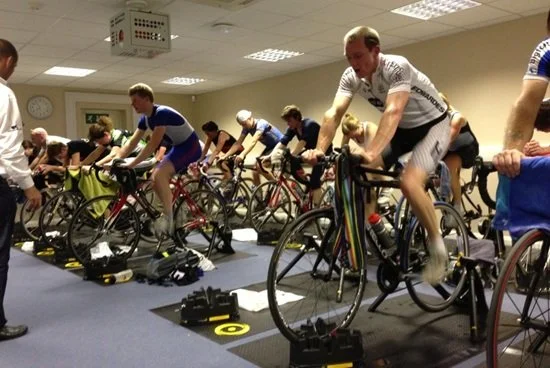
If that’s true, another question naturally follows: how can two athletes complete exactly the same workout and experience very different physiological responses? It’s a reality most coaches have observed. Two athletes line up on Tuesday night. Both complete 4 × 4 minutes, both hit the prescribed power, both finish exhausted. Yet when we review the data afterwards, one athlete has accumulated nearly ten minutes above 90% of maximum heart rate while the other has spent barely four. Both completed the workout but did they complete the same training session? From the perspective of external load, yes. From the perspective of internal load, perhaps not. And that’s where coaching becomes interesting.
The Missing Piece
Most training plans assume there’s a “best” VO₂max workout: 4 × 4, 5 × 3, 6 × 2, 30/30, 40/20, 30/15 and the debate usually centres on which one is superior. I believe that that’s the wrong question. The better question is “which workout allows this athlete to accumulate the greatest aerobic stimulus”? It’s a subtle but important shift: instead of comparing workouts, we’re comparing physiological responses.
Imagine prescribing the same VO₂max session to twenty athletes. Would you expect twenty identical adaptations? Probably not. So why would we expect that same workout prescription to be equally effective for all twenty?
Two Different Ways of Reaching Your Limit
Physiologists sometimes describe athletes as being more ceiling-limited or more kinetics-limited. Don’t get too caught up in the terminology - these aren’t diagnoses, and they’re certainly not fixed labels. Think of them as working hypotheses that help explain why athletes respond differently to interval training, and like any good hypothesis, they’re there to be tested, not believed blindly.
One simple way to get a feel for where you might sit is to look at the gap between your FTP and your Maximal Aerobic Power (MAP), the highest power your aerobic system can sustain for around five minutes. A small gap suggests you’re already working close to your aerobic ceiling when you’re at threshold. Push above FTP and you’ll quickly run out of room, so heart rate tends to climb fast. A large gap suggests there’s meaningful aerobic capacity sitting above threshold. Pushing above FTP doesn’t immediately put the same strain on the cardiovascular system, so heart rate can be slower to respond.
A Ceiling-Limited Athlete
Imagine an athlete with a small gap between FTP and maximal aerobic power (MAP). They settle into hard efforts quickly: their breathing becomes heavy relatively early in an interval, and their heart rate climbs steadily. They’re often capable of holding a demanding effort for the entire repetition.
The challenge isn’t getting their aerobic system working. It’s that their aerobic ceiling simply isn’t especially high above FTP so they’ll be trending close to max even when working just above threshold.
On the road, this pattern often shows up as strength in sustained, steady efforts, time trials, long climbs, solo breakaways, but a tendency to get gapped when the pace surges hard, since there isn't much aerobic ceiling left above what they're already holding.
A Kinetics-Limited Athlete
Now imagine another athlete with a larger gap between FTP and MAP. The first minute of every interval looks brilliant: huge power, explosive acceleration. Then things start to unravel. Their breathing takes longer to catch up, heart rate rises more slowly, but the metabolic waste/cost of the work is high and slows them down before the cardiovascular stress becomes meaningful.
That large gap between FTP and MAP points to real aerobic potential above threshold, the challenge is accessing it quickly enough. Early in the interval, before oxygen uptake catches up, more of the effort gets fuelled anaerobically, and that's a finite reserve. It burns down fast, which is why the effort unravels before the aerobic system ever gets to do the heavy lifting
On the road, this pattern often shows up as the ability to close a gap or produce a big, punchy effort, attacks, hard accelerations, short surges, but a tendency to fade if that intensity has to be sustained.
These Aren’t Labels
This is where I think coaching sometimes goes wrong. It’s tempting to decide “I’m a kinetics athlete” or “I’m ceiling-limited,” but reality is rarely that simple. Your physiology may change as you become fitter, and fatigue, heat and even the time of season can all shift your response. That’s why I prefer to think of these concepts as starting hypotheses, not conclusions.
What Does Your Power Profile Suggest?
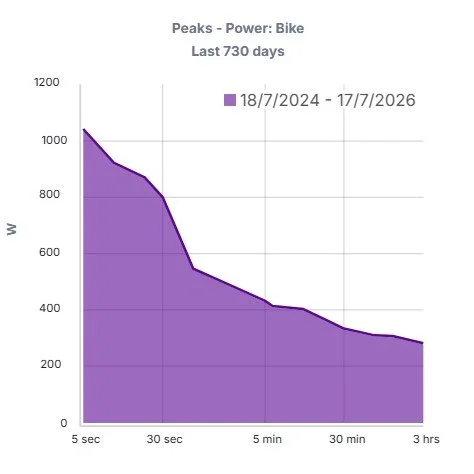
One place to begin is with your power-duration curve, not because it gives us the answer, but because it may provide useful clues. Look at three numbers: one-minute power, five-minute power and FTP or critical power.
Suppose Athlete A has an FTP of 300W, a five-minute power of 325W and a one-minute power of 410W. The relatively small gap between FTP and five-minute power suggests this athlete is already working close to their aerobic ceiling once they hit threshold, there isn't much room between what they can sustain and where their aerobic system tops out.
Now consider Athlete B, with the same FTP of 300W but a five-minute power of 345W and a one-minute power of 570W. The much larger anaerobic contribution suggests a very different physiology.
Again, this doesn’t prove anything. It simply generates a hypothesis.
Coach’s Notebook
One of my favourite sayings in coaching is that data rarely gives us answers, it gives us better questions. A power profile doesn’t tell you which interval session you should do, it tells you which interval session might be worth trying first.
Turning Data Into Experiments
This is where the science becomes coaching. Suppose your power profile suggests you may be more kinetics-limited. What should you do? Don’t change your entire training programme, run an experiment. Over the next few weeks, compare two different interval formats, perhaps 4 × 4 minutes against 30/30s for 15 minutes, keeping everything else as similar as possible. Then compare the outcomes, and not just the power. How repeatable was the session? How much time did you accumulate above approximately 90% HRmax? How hard did it feel? How well did you recover? Could you repeat it again in two or three days?
You’re no longer trying to prove one session is superior. You’re trying to discover which session appears to produce the greatest aerobic stimulus for your physiology.
There May Not Be One Perfect Session
One final thought. Athletes often ask what the best VO₂max workout is. I don’t think there is one. There may be a workout that’s best suited to your physiology today, but that doesn’t mean it’ll still be the best in six month’s time. As your aerobic system adapts, your response to different interval formats may also change. Good coaching isn’t about finding the perfect workout. It’s about continually matching the prescription to the athlete standing in front of you.
Looking Ahead
If different athletes respond differently to different interval structures, the next logical question is how we actually test that in practice. How do we compare two interval sessions? What should we measure? And how much evidence do we need before changing our training?
In Part 3 we’ll build a practical framework that helps you become your own physiologist, using experiments rather than assumptions to individualise your VO₂max training.
Bevan McKinnon / July 2026
References
Poole, D.C., & Jones, A.M. Oxygen uptake kinetics as a determinant of sports performance. (Basis for treating VO₂ kinetics as a distinct trait from VO₂max itself, and for the O₂-deficit / anaerobic-reliance mechanism underlying the kinetics-limited athlete description.)
High North Performance. VO₂ Kinetics Explained For Cyclists. highnorth.co.uk. (Applied summary of the central/peripheral factors governing VO₂ on-kinetics.)
Aerobic fitness level typical of elite athletes is not associated with even faster VO₂ kinetics during cycling exercise. PMC. (Confirms VO₂ kinetics as a measurable, individual trait separate from aerobic fitness level, supporting the ceiling-limited/kinetics-limited framing as a working hypothesis rather than an invented distinction.)