
VO₂max Training (Part 3): Becoming Your Own Physiologist
How to experiment with interval training instead of copying someone else’s!
If you’ve read Parts 1 and 2, you’ve probably already worked something out. There isn’t really a single “best” VO₂max workout. There are simply different ways of persuading the aerobic system to work near its limit, and every interval format is just another tool for doing that. I like that reframe because it changes what a coach is actually doing. You’re no longer prescribing workouts, you’re explaining their purpose.
THE TOOLBOX
Every VO₂max session manipulates one or more of the same handful of variables: power, duration, recovery, cadence, starting strategy and repeatability. Different workouts aren’t fundamentally different tools, they’re the same small set of levers pulled in different combinations.
Tool 1: Continuous Intervals
The classic format: 4 × 4 minutes, 5 × 3, 6 × 2, 3 × 8 and their many variations. The purpose is straightforward, maintain a high sustained aerobic demand - tends to work well for athletes who reach a high aerobic stress reasonably quickly and can hold it there.
The strengths are practical ones: continuous intervals are simple, repeatable, easy to monitor and progress predictably over a training block. The main limitation is that some athletes spend a meaningful chunk of each interval just “getting there” before the aerobic system is actually under load.
Tool 2: Fast-Start Intervals
A fast-start interval flips the order: roughly 30 seconds very hard, followed by three and a half minutes at a slightly easier intensity. The purpose is to accelerate oxygen uptake early in the interval. The hard start creates an oxygen deficit and that deficit appears to encourage VO₂ to rise more rapidly than it would with an even effort.
The potential advantage is spending more total time near VO₂max without extending the overall duration of the session.
Tool 3: Micro-Intervals
Micro-intervals, formats like 30/30, 40/20 and 30/15 repeatedly elevate oxygen demand while never allowing full recovery. The recovery period is short enough that oxygen consumption doesn’t fall very far before the next effort begins, which can allow a substantial amount of accumulated aerobic stress despite a lower average power than a continuous interval.
Tool 4: High-Cadence VO₂ Work
Increasing cadence during VO₂ intervals reduces the muscular force required per pedal stroke while increasing cardiovascular demand due to the increase number of muscular contractions. This can be useful for athletes who become locally muscularly limited, their legs give out, before they become aerobically limited.

Tool 5: Low-Cadence, High-Torque VO₂
This one’s a bit more exploratory. Reducing cadence and increasing torque shifts the demand toward muscular recruitment rather than cardiovascular output, and there’s a reasonable hypothesis that this could benefit athletes who are limited more by maximal aerobic power than by cardiovascular capacity, with some potential for greater peripheral adaptation alongside it. The evidence here is thinner and more mixed than for the other formats, so I’d treat it as a tool worth experimenting with rather than a default recommendation.
Tool 6: Variable-Power Intervals
Rather than holding a constant power throughout the effort variable-power intervals oscillate (around 110% down to 90% and back) repeated through the interval, or a set of over-unders built around maximal aerobic power. These manipulate the physiological stimulus differently again, adding a layer of surging on top of the sustained demand.
Tool 7: Reduced Recovery
Sometimes the interval itself doesn’t need to change at all. Take a standard 4 × 4 and simply shorten the recovery, from three minutes down to two, then down to ninety seconds and you’ve created a meaningfully different stimulus without touching the work interval.
Ask the Right Question
Once you’re thinking in terms of tools rather than a single best workout the question changes. Instead of asking which session is best, ask which session allows you to produce repeatable power, recover well, accumulate meaningful time above 90% of your maximum heart rate, and keep progressing over the next six weeks. That’s a question only your own data can answer.
Coach’s Notebook
Most athletes collect workouts - good coaches collect observations. Every interval session tells you something about your physiology, and the trick isn’t finding the perfect workout, it’s recognising which workout consistently creates the internal response you’re trying to achieve.
A Simple Comparison
To bring the toolbox together, here’s how these formats compare, not in terms of which is “best,” but in terms of what each is likely to do and what’s worth watching for when you try it.
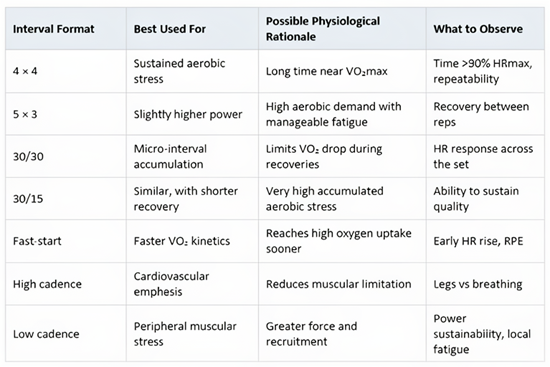
Notice the final column isn’t “expected result.” It’s “what to observe.” That single distinction captures the philosophy of this whole series. You’re not being handed a recipe, you’re being given a framework for experimentation and that’s a far more enduring lesson than being told which interval session is supposedly best.
There’s a vast array of VO₂ workouts once you go looking for them. Once you’ve trialled a few, as a rough benchmark, most research and coaching practice converges on somewhere around 10 to 20 minutes of accumulated time spent above roughly 90% of VO₂max as a practical target for a single session - sometimes extending toward 20-25 minutes for well-trained athletes. That's not the same as total session length or even total interval time, since part of every interval is spent ramping up before you're actually near the ceiling. It's also not a hard limit so much as a converging range: push meaningfully past it and quality tends to drop while fatigue and injury risk climb faster than the extra benefit justifies
Becoming Your Own Physiologist
One of the biggest mistakes in endurance sport is believing that successful athletes simply copy the best workouts. In reality, successful athletes and coaches spend years learning how their own physiology responds to different kinds of training. Power helps us prescribe - heart rate helps us evaluate. Recovery tells us whether the stress was appropriate - adaptation tells us whether we got it right.
That’s why becoming a better athlete was never really about collecting more interval sessions. It’s about becoming a better observer of your own physiology.
Bevan McKinnon / July 2026
References
Rønnestad, B.R., et al. Fast-start interval studies in cross-country skiers and cyclists. (Basis for Tool 2: fast-start intervals and their effect on time spent above 90% VO₂max.)
Rønnestad, B.R., et al. (2015). Short intervals induce superior training adaptations compared with long intervals in cyclists – an effort-matched approach. Scandinavian Journal of Medicine & Science in Sports, 25, 143–151.
Rønnestad, B.R., et al. (2020). 30/15 interval studies. Scandinavian Journal of Medicine & Science in Sports. (Basis for Tool 3: micro-intervals.)
Habis, R., & Habis, P. (2024). Greater improvement in aerobic capacity after a polarized training program including cycling interval training at low cadence (50–70 RPM) than freely chosen cadence. PLOS ONE. (Found low-cadence interval training produced larger VO₂max gains than freely-chosen cadence in well-trained female cyclists.)
Nimmerichter, A., et al. Low cadence interval training at moderate intensity does not improve cycling performance in highly trained veteran cyclists. PMC. (Contradicts the Habis & Habis finding above in a different population; cited together to show the evidence on low-cadence VO₂ work is genuinely mixed, which is why Tool 5 is hedged more heavily than the other tools in the article.)