
Beat Yesterday, Lose Tomorrow
Why chasing yesterday's numbers quietly undermines tomorrow's session
A swimmer holds best-effort pace on every interval in the set because slower splits feel like fitness left on the table. A runner's easy day drifts a little quicker each week because last week's Strava segment is sitting right there to beat. A cyclist's endurance ride creeps towards the top of the prescribed power range because more watts reads as more training stress banked for the week. Most athletes think fitness is driven by intensity and that intensity exists on a single line: harder equals more adaptation, easier equals less adaptation.
This is true to a degree but athletes can easily get caught out in trying to confirm fitness changes on a day-to-day basis by following the external metrics data. The logic plays out like this: The swimmer's logic: last week's best interval pace means this week's needs to match it or beat it. The runner's logic: last week's easy pace averaged 5:00 per km, so this week's needs to be that fast or faster. The cyclist's logic: the coach prescribed zone 2, so let's sit right at the top of it.
That habit is easy to miss because it doesn't look like overtraining. It looks like application. But it rests on an assumption worth examining: that within a given intensity, more is always better, and a session's success can be read off whether today's numbers beat yesterdays.
Training as a Spectrum, not a Scoreboard
What training actually asks of the body isn't a series of numbers to hit. It's exposure to a spread of intensities, wide enough and varied enough that a broad range of physiological and metabolic systems get a reason to adapt. The zones used to organise that - easy, moderate, threshold, VO2max - are useful shorthand, but they're labels drawn over a continuous curve, not separate compartments with a switch at the door of each.
An expert consensus on so-called ‘Zone 2’ training, published in 2025 in the International Journal of Sports Physiology and Performance, put this plainly. The panel concluded that physiological responses to rising intensity are better explained as a continuum than as adaptations that switch on and off at zone boundaries and that they didn't expect meaningfully different adaptations from the top of one zone and the bottom of the next, compared with the middle of either. In other words, a session held comfortably inside a zone is producing much the same signal as one dragged to its upper edge. Yes, the signal gets stronger as intensity rises — but so does the fatigue cost, and sustainable training means weighing the two.
I think the common phrase ‘make the easy training easy so you can make the hard training hard’ springs to mind. In my experience many amateur athletes chase best external metric performance in most of their sessions when an easy session should provide useful aerobic work at the lowest practical metabolic and mechanical cost, while helping restore muscular readiness for the next key session. Success isn't simply completing today's prescribed volume or pace; it's finishing today's training in a state that allows tomorrow's important training to be performed well.
Athletes however can be drawn to measuring the success of a workout by whether it was more powerful or faster than the last and external metrics are the most common way to try and calculate this. Fitness doesn’t materially change on a day-to-day basis but fatigue does. And if we’re always trying to beat yesterday to help us confirm the direction our training is heading then we can easily get caught up in external metrics as a carrot to chase. To some extent, it’s a form of confirmation bias - athletes wanting reassurance that they’re heading in the right direction.

Getting Internal and External the Right Way Round
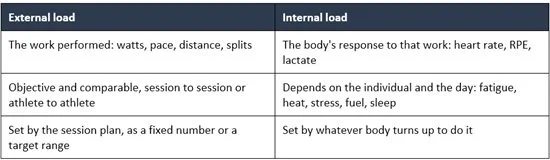
It helps to be precise about what's actually being described here because it's a common mix-up. External load is the work itself - watts, pace, distance - the numbers a session plan can specify in advance and that read the same regardless of who's producing them. Internal load is the body's response to that work - heart rate, perceived exertion, blood lactate, fuel preference - and it's shaped entirely by whoever's doing the session and what kind of day they're having. Whilst we prescribe external metrics to direct the workout, it's information about how the body is coping whilst working close to those targets that matters most.
Franco Impellizzeri and colleagues, revisiting a distinction they first proposed in 2003, made this the core of how sports science now thinks about load. External load is what's prescribed. Internal load is what it costs. And it's the internal response, not the external number, that the body actually adapts to. Two athletes completing an identical external session can come away with meaningfully different training effects, and the same athlete can produce a very different internal response to an identical session depending on fatigue, heat, sleep, fuelling or stress.
This is exactly why chasing the top of a power or pace range, or bettering last week’s workout, or chasing a Strava segment is such an easy trap. Watts and pace are external, visible and directly comparable to last week, to a training partner, to a personal best. They give us ‘confirmation’ we’re improving
Heart rate and RPE aren't nearly as easy to screenshot or compare, even though they're the numbers actually telling you how the body coped from a physiological perspective. The visible metric gets treated as the goal, when it was only ever meant to be a way of aiming your efforts towards the right intensity.
Letting the Target Flex
This matters most on the days the body doesn't show up fresh. A session built around a fixed FTP or threshold pace assumes the number, generally set after a fresh test session, still holds true every day, even though the body is in a constant state of flux. Poor sleep, a heavy week, or simple accumulated fatigue can turn a ‘fresh FTP’ into something closer to a ‘fatigued FTP’ for that day alone. An athlete who holds the old number regardless isn't training harder, they're training at a higher relative intensity than the session intended, dressed up in the same absolute number as always. Reading the internal response, heart rate for a given effort, how heavy the legs feel and adjusting the external target to match, keeps the athlete working the same zone from wherever their body actually sits that day.
Research on flexible, internally-anchored training backs this. Kiviniemi and colleagues (2007) and later Javaloyes and colleagues (2020) both found that adjusting daily intensity based on heart rate variability produced fitness gains at least equal to fixed periodisation, with fewer signs of accumulated fatigue along the way. Letting the target move didn't cost fitness, it protected it.
Using the Carrot Properly
None of this is an argument for ignoring external numbers. It's an argument for being clear about what job they're doing. Session to session, the question worth asking isn't ‘did I hit the number?’ it's ‘was I in the right zone for what today's body could give.’ External numbers help Coaches prescribe training that the athlete can follow so they arrive at a general intensity range and stay there for the desired duration. We can certainly review those numbers post workout but their value isn't so much in day-to-day growth. Rather they earn their keep over a longer window: read across weeks rather than any single session, they're the honest, lagging evidence of whether the whole approach is working, the carrot worth chasing across a season, even while the day-to-day target flexes underneath it.
Bevan McKinnon / August 2026
Resources:
Sources: Sitko S, Artetxe X, Bonnevie-Svendsen M, et al. What Is "Zone 2 Training"? Experts' Viewpoint on Definition, Training Methods, and Expected Adaptations. Int J Sports Physiol Perform. 2025;20(11):1614-1617.
Impellizzeri FM, Marcora SM, Coutts AJ. Internal and External Training Load: 15 Years On. Int J Sports Physiol Perform. 2019;14(2):270-273.
Kiviniemi AM, Hautala AJ, Kinnunen H, Tulppo MP. Endurance training guided individually by daily heart rate variability measurements. Eur J Appl Physiol. 2007;101(6):743-751.
Javaloyes A, Sarabia JM, Lamberts RP, Plews D, Moya-Ramon M. Training prescription guided by heart rate variability vs. block periodization in well-trained cyclists. J Strength Cond Res. 2020;34(6):1511-1518.